Showing posts with label linq. Show all posts

Friday, May 1, 2015

LINQ in Entity Framework

To retrieve lists from database you can use IEnumerbale<T> or IQueryable<T> interfaces. IQueryable allows you to do LINQ-to-SQL while IEnumerable<T> is LINQ-to-Objects. Both gives you the opportunity to do deferred execution. (Read this article for more).

In IEnumerable all objects matching the original query will be loaded to the memory from database. 

Above first and last LINQ statements will generate first SQL query while second LINQ expression will generate the second query below,

LINQ First and FirstOrDefault


LINQ Single and SingleOrDefault


LINQ Any
Note that Count will iterate all the records in the table while Any will stop at first record it finds. (source)

LINQ Count and LongCount

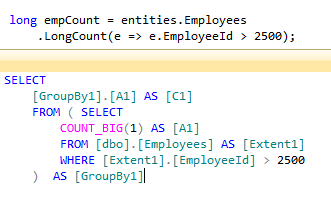

The difference between Count and Count_Big is latter returns bigint while count returns int. See more details on data types.

LINQ Contains


Group by
Wednesday, May 7, 2014

Understanding IEnumerable and IQueryable in C#

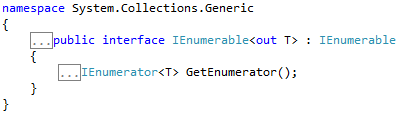
IEnumerable<T> is the base interface for collections in System.Collections.Generic namespace. IEnumerable<T> exposes the enumerator which supports iteration over a collection of a specified type. For non-generic types .NET has another interface called IEnumerable. See the difference between IEnumerable<T> and IEnumerableIEnumerable<T> has a single method GetEnumerator which you must implement when implementing the IEnumerable<T> interface. This returns a IEnumerator<T> object.


IQueryable<T> provides functionality to evaluate queries against a data source. This exists in System.Linq namespace. This inherits IEnumerable<T> interface thereby if it represents an query it can be enumerated. Enumeration forces associated expression tree to be executed.


Difference between IQueryable<T> and IEnumerable<T>
Both will give the ability for deferred execution but IQuerayable allows you to LINQ to SQL while IEnumerable does not. IEnumerable only allows LINQ to Object. IQueryable if possible will execute on database. 

AsEnumerable
Allows you to cast a specific type to its IEnumerable equivalent. In LINQ you can use this to run part of the query in SQL and the other part in memory as LINQ to Objects. One reason because when execute in memory we have more methods to work with than in database. (Ref)


AsQueryable
Converts IEnumerable to an IQueryable.

When exposing any of these interfaces to a client, the developer should design the API such that only the required details are exposed to the outside. 
Source - Stackoverflow
Also see questions for IEnumerable under stackoverflow

IEnumerable<T> has lot of extension methods. Check them here.

Provides a set of static methods for querying objects that implements IEnumerable<T>. This can be found under System.Linq namespace.

Enumerable.Empty<TResult>
Returns an empty IEnumerable<T>. 

Friday, July 13, 2012

Powered by Blogger.


Software Architect at Surge Global/ Certified Scrum Master

Experienced in Product Design, Software Engineering, Team management and Practicing Agile methodologies.

Search This Blog

Facebook